
Why deals are lost after the call: unkept promises and deal-breakers
· Updated
Score every call against your checklist, not a sample
Request a demoA customer is ready to buy, and the rep says: "I'll send you the quote tomorrow." A week passes. The quote never goes out, the customer moves to a competitor, and the deal in the CRM still reads "In progress". Losses like this look random, but listen to the calls and you will almost always hear unkept promises and deal-breakers the rep missed.
In short: deals are usually lost in the pause after the call. A promise goes unkept, a refusal signal goes unnoticed, or there is no next step. Speech analytics finds these moments in every call: AI lists the rep's promises and the customer's deal-breakers and shows the manager where to step in.
Why a deal dies after the conversation, not during it
During a call the rep tries hard: answers questions, shows the product, agrees on terms. The money is lost in the pause afterward:
- The promise is not kept. "I'll send the quote", "I'll call back Thursday", "I'll check with the engineer", and then silence.
- The promise is not recorded. The rep remembers, but no task exists in the CRM. A day later they have moved on to other customers.
- A refusal signal goes unnoticed. The customer said "we're comparing several suppliers", and the rep took it as a neutral remark.
- There is no next step. The call ended with "I'll write to you", with no date and no agreement.
- A handoff between reps. The new rep does not know what was agreed and starts the conversation over.
The manager sees only the outcome: the customer did not come back. The cause stays unknown because the manager never heard the call.
Customer promises: what they are and why to track them
A customer promise is any action a rep takes on in a conversation: send a proposal, call back, prepare a contract, check availability, approve a discount. To the customer it is a signal of reliability. An unkept promise turns a good conversation into a reason to walk away.
A typical story: a rep got a finished quote from colleagues and never passed it to the customer. The deal was lost. Such a case is hard to spot without listening, because the CRM has neither a task nor a message. The recording does have the phrase: "I'll send the quote today before lunch."
How Leksta finds promises in calls
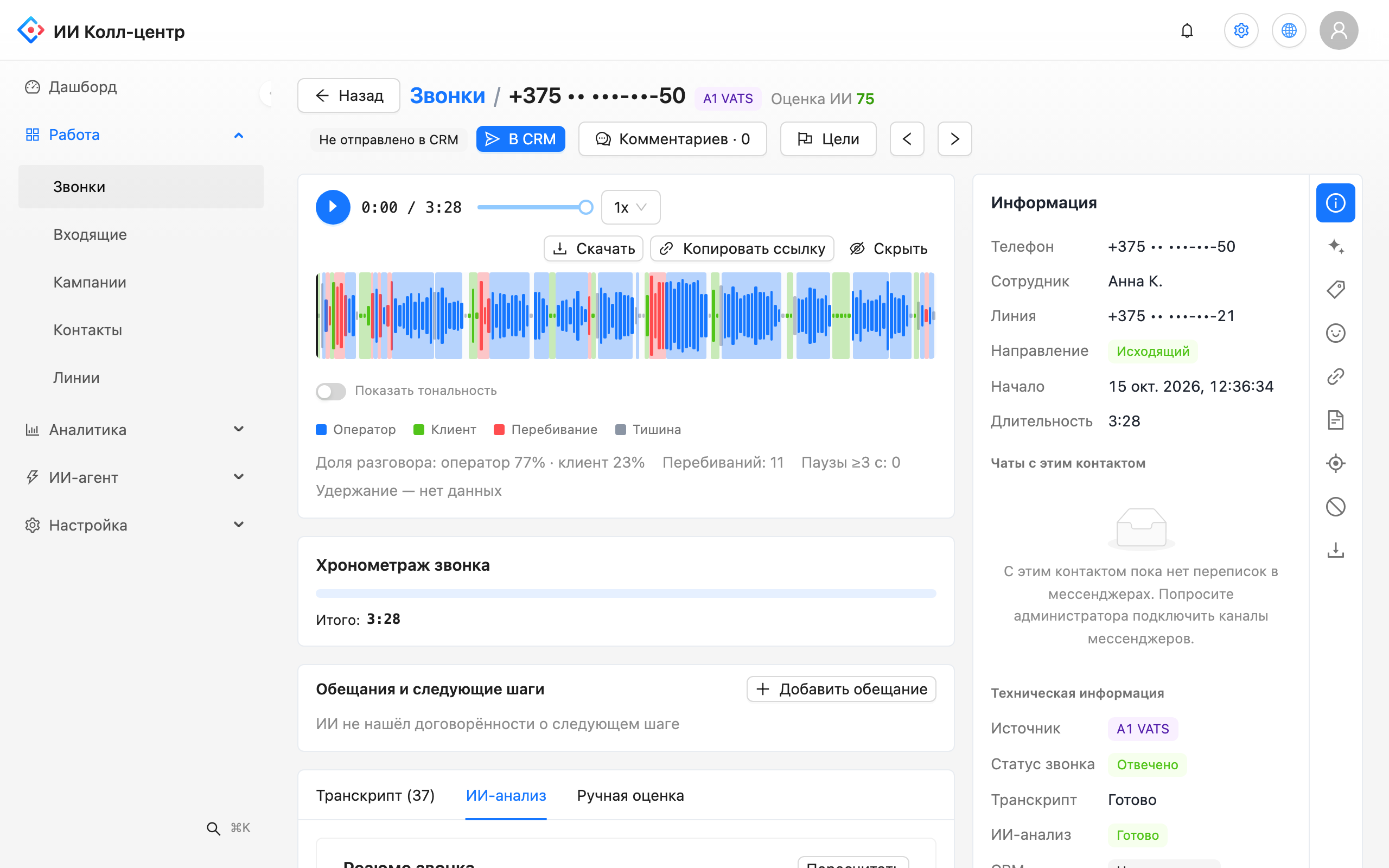
AI transcribes the conversation and extracts the rep's promises: what exactly was promised, to whom and by when. Then the data works for the manager:
- A list of promises per customer. The contact card shows what the rep promised in recent calls.
- Fulfillment check. A promise can be matched against a CRM task, so you see where none exists.
- Result sent to the deal. The call summary and promises go to the card in amoCRM (Kommo) or Bitrix24, where the rep already works. More in the article on the call score in the deal card.
- A link to the moment in the recording. The manager clicks a promise and hears how it was said.
Deal-breakers: signals after which a deal collapses
A deal-breaker is a phrase or situation in a conversation that says the customer is ready to leave. If the rep notices it and handles it, the deal goes on. If not, it is lost.
Examples of deal-breakers across industries:
- the customer compares you with competitors and names their terms;
- a price objection comes up a second and third time;
- the customer asks to send everything by email and cuts the conversation short;
- the rep cannot answer a direct question;
- the customer is unhappy and says so, and the tone of the call changes;
- there is no contact with the decision maker.
Which deal-breakers matter depends on your business. For renovation and windows they are deadlines and the estimate, for real estate they are credit and installments, for clinics it is the price of a visit. You describe them in a checklist in your own words, and AI looks for them in every conversation.
What the manager sees
A manager does not need to listen to everything. The system shows where to look first:
- An attention queue. Calls with deal-breakers, missed required items and unkept promises come first.
- A customer mood chart across the call. You see where the customer was left unhappy and can open that fragment right away.
- A one-line AI conclusion. What went well, what to fix, what the next step is.
- A link to the moment in the recording. Any conclusion can be checked by ear in seconds.
Want to review your own calls this way?
14 days and 120 minutes of calls free, no card
Example of a call review
Below is a synthetic example of a call review that helps win a deal back.
| Moment in the call | What AI heard | What the manager sees |
|---|---|---|
| Needs discovery | The customer names the date they need the result by | Item done, date recorded |
| Objection | The customer says another company is cheaper | Deal-breaker: "comparison with competitors" |
| Promise | Rep: "I'll send the quote today by five" | A promise with a deadline, a task to verify |
| Closing | "Okay, I'll write to you" | A next step without a date: item missed |
The manager opens the call in a minute and decides: remind the rep about the quote, offer a discount or join the deal personally. The decision is made on the day of the call, not after the customer has left.
How to estimate what you are losing now
You do not need a long study to see the scale of the problem:
- Take 20-30 anonymized recordings from any week.
- Check how many promises were made and how many were turned into CRM tasks.
- Mark the calls that ended with no date for a next step.
- Find recurring deal-breakers: which objections your reps fail to handle.
In Leksta this analysis runs automatically for all calls, and you get a ready picture for the whole team instead of a sample of ten recordings. For a comparison with manual review, see the article on how speech analytics covers 100% of calls.
How to win a deal back before the customer leaves
The main advantage of automatic review is speed. If you learn about a missed promise a week later, the customer is gone. If you learn the next day, you can still win them back:
- call and keep the promise, with an apology;
- offer an alternative if the deadline was missed;
- hand the deal to another rep, who sees the whole history in the customer portrait;
- go over the case with the rep and lock in the rule: every promise is a task in the CRM.
AI customer profile: context for the next call
So that a repeat conversation does not start from zero, Leksta builds an AI customer profile: communication style, attitude to price, recurring objections and unkept promises. Before a call the rep opens the card and immediately knows what matters to the customer and what they were already promised. This is especially useful when several reps handle one customer.
How to teach reps not to lose promises
Technology only helps; habits are built by people. What works:
- A "promised, recorded" rule. After every conversation the rep creates a task for the promise.
- A required checklist item. "Agreed on a next step with a date." If it is missing, the score drops.
- A review at the team meeting. Take one call with an unkept promise and go through it without looking for someone to blame: what got in the way.
- Practice. Reps rehearse objection scenarios in the AI trainer before a live conversation.
Sales script control for every call is described on the sales script control page, and the overall feature set on the speech analytics page. Terms are on the pricing page.
Try Leksta free
How many promises and deal-breakers go unnoticed in your conversations? Upload a few recordings, and Leksta will show where deals are lost after the call. No card is needed to start.

FAQ
Why do deals fall through after a call with a customer?
Most often because of unkept promises, missed refusal signals and conversations with no next step. A rep promises to send a quote or call back, does not record it in the CRM and forgets. The customer reads this as unreliability and leaves.
How do I track the promises my reps make to customers?
Connect speech analytics: AI transcribes the calls and extracts the rep's promises. The manager sees them in a list and in the deal card with a link to the moment in the recording, and can check whether the promise was kept on time.
What are deal-breakers in sales?
Deal-breakers are signals in a conversation after which a deal risks falling apart: a mention of competitors, a repeated price objection, a conversation cut short, an unanswered question. You describe them in a checklist in advance, and the system finds them in all calls.
How do I find out why a customer did not come back after a call?
Open the recording and find how the conversation ended. Automatic review shows the AI conclusion, the customer's mood through the call and unkept promises, so the cause is visible in a minute rather than an hour of listening.
Try Leksta on your own calls
Connect your PBX and get your first scores within 14 days, free, no card needed
Related articles
Send Asterisk Call Recordings to Leksta Over HTTPS
HTTPS push sends each finished Asterisk or FreeSWITCH call recording to Leksta over an encrypted connection that your PBX opens itself. It needs one small agent and a revocable token, and it works in the cloud and on-premise. Compare it with SFTP pull and Shared folder.
Lost deal reasons: how to capture them from calls and act on them
The most reliable way to track lost deal reasons is to take them from conversations, not from a rep's memory. Keep a short list of reasons, record one for every lost deal, and write "reason not stated" when the customer gave none. Review the trend weekly, then change the script, the price or the process.
Lead vs Deal: What to Create in Your CRM After a Call
A lead is an inquiry where it is not yet clear whether the person will buy. A deal is an actual sale with stages, an amount and an owner. If calls come from mixed sources and some are random, create a lead and qualify it. If almost every call is already an order, create a deal. Bitrix24 example inside.