
Sales rep call KPIs: plan vs. actual and new-hire ramp-up
· Updated
Score every call against your checklist, not a sample
Request a demoSales rep call KPIs are targets for activity and quality: how many numbers to dial, how many conversations to hold beyond a set length, and what scorecard score to reach. In Leksta, plan vs. actual for these metrics is built automatically from call recordings: per rep, per day, week and month, with no manual spreadsheets.
Usually a sales manager learns how many calls a rep made only at the morning stand-up, when reps type their own numbers into a table. The data arrives late and secondhand.
Which call KPIs to track
The set depends on your team's goals, but it almost always falls into two groups.
Activity. How much a rep works with customers:
- numbers dialed per day;
- conversations longer than a set length, for example three minutes, since short calls rarely lead to a deal;
- total talk time and time online.
Quality. How a rep talks:
- average scorecard score;
- share of calls where all required script items are completed;
- how objections were handled;
- conversion from a call to a next step: a booking, a meeting, a payment.
Activity without quality turns into a race for volume. Quality without activity gives lovely scores on three calls a day. Plan vs. actual works when both groups are visible in one place.
Plan vs. actual in Leksta
You set a target for a rep or for the whole team: for example, at least a given number of dials a day, at least a few conversations longer than three minutes, at least a given time online. The system then matches the target to the recordings on its own.
A manager sees:
- plan completion for each rep over the chosen period;
- deviations: who dropped and on which day;
- daily, weekly and monthly summaries: how many calls, total duration, what went well and what to fix;
- a comparison of reps against each other on the same metrics.
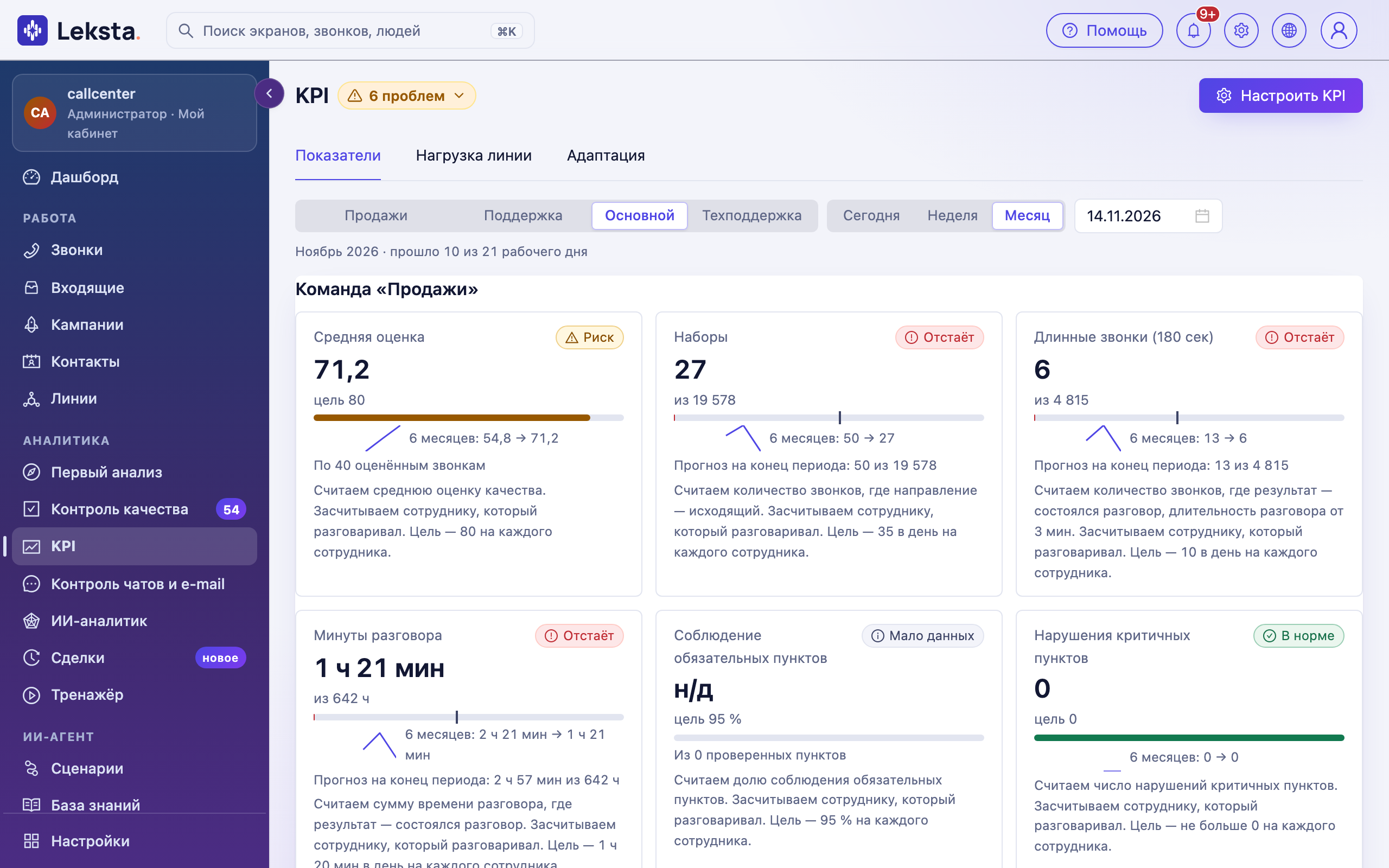
The table that used to be assembled by hand before the stand-up is ready at the start of the workday. The meeting is spent on decisions, not on reconciling numbers.
Filters that keep KPIs fair
Not every call reflects a rep's work. An answering machine, a hang-up on the third second and a wrong number inflate activity and spoil scores. So in Leksta you can:
- cut short calls with a duration threshold and analyze only conversations of the right length;
- separate first-time and repeat customer contacts: they have different goals and different conversion;
- separate inbound and outbound calls;
- view metrics by touch: first call, second, third.
This way you compare reps on comparable conversations, not on a random set of recordings.
New-hire ramp-up: how to shorten the path to quota
While a new rep ramps up to the KPIs, a manager or mentor has to check their calls to fix mistakes in time. That is expensive, and there is no time left for other reps.
Automatic scoring changes the process:
- Every call of a new rep is scored against the scorecard. The mentor sees the trend on each script item from the first week.
- The attention queue shows what to listen to. Instead of random calls, the mentor opens those with a low score or missed required items.
- Feedback with a link to the moment. The mentor sends a comment, the new rep opens the call at the right second and confirms they have read it.
- Practice before a real call. If a new rep has a weak spot, such as the "too expensive" objection, they drill it in a dialogue with the AI sales trainer instead of on a live customer.
- A ramp-up curve. The manager sees how the new rep approaches the plan and adjusts the workload or training format in time.
More on scoring reps as a whole: rep evaluation by calls.
How to read plan vs. actual: four questions for the numbers
A plan-completion table does not answer everything on its own. Four simple checks help:
- Is the activity plan met? If not, look at which days dipped and whether it matches vacation, illness or other tasks.
- Is the scorecard score growing? A rep who makes many calls with low scores wastes the customer base. They need coaching, not another target.
- Which script items sag across the whole group? If the problem is shared, fix it with group training, not individual remarks.
- What happens to deals after the calls? A good score with zero results means the scorecard lacks an important criterion, and it is worth adding.
These questions turn plan vs. actual from a box-ticking report into a decision tool.
Want to review your own calls this way?
14 days and 120 minutes of calls free, no card
Common mistakes when introducing call KPIs
- Too many metrics. Nobody remembers seven or eight metrics per rep. Start with three to five and add as needed.
- One target for everyone. An inbound rep and a cold-calling rep have different jobs. Set targets by role.
- Quantity only. If you measure only dials, reps start hanging up after the greeting. Always keep quality next to it.
- No feedback. KPIs without feedback turn into pressure. After each period, discuss the numbers with the rep and agree what to improve.
- Targets never revisited. If everyone meets a target without effort, it shows nothing. Revisit it as the team grows.
Corrective training instead of penalties
Many teams do not want a system where a score automatically becomes a penalty. The numbers exist to show what to teach, not whom to punish. Leksta supports exactly that process:
- a manager sees a rep's strengths and weaknesses for the period;
- if two or three reps share the same problem, it is a reason for a role-play session for the whole group;
- every review is recorded: the rep gets a comment, opens the recording and confirms they have read it;
- the next period shows whether the training helped.
KPIs become a mentoring tool, and reps see the numbers as help, not control for its own sake.
How to connect KPIs to deals
Calls are only part of the funnel. KPIs are worth more when the outcome of a conversation is visible in the CRM. Leksta sends the call result to the deal card in amoCRM (Kommo) and Bitrix24: the score, a short conclusion and the promises made to the customer. We will connect Leksta to your CRM and set up what exactly to send; details are on the integrations page. A manager sees both a rep's activity and what happens to deals after their calls.
How to start
- List the three to five metrics you count by hand today.
- Connect recordings or upload 20 to 30 anonymized calls.
- Set targets and a scorecard, then look at plan vs. actual for last week.
- Decide which reports each manager needs: by rep, by group, by new hires.
The overall picture is on the speech analytics page, and terms are on the pricing page.
Try Leksta free
Want to see plan vs. actual for your reps without spreadsheets and manual counting? Try Leksta: up to 600 call minutes free, no card. Upload recordings, and Leksta shows activity, scorecard scores and the trend for each rep.

FAQ
Which call KPIs should I track for sales reps?
Track two groups. Activity: dials, conversations longer than a set length, time online. Quality: scorecard score, share of completed required script items and conversion from a call to a next step. Together they show both how much a rep works and how well.
How do I build plan vs. actual for calls without manual spreadsheets?
Set targets in the speech analytics system. It counts actuals from call recordings and compares them with the plan for each rep by day, week and month. Reps do not enter numbers by hand, and a manager sees deviations before the stand-up.
How can I get a new sales rep up to speed faster?
Score all of their calls against a scorecard from week one, listen only to the problem ones and review mistakes with a link to the recording moment. Drill weak spots in an AI trainer before the next real call. The manager sees how the new rep approaches the plan.
How do I exclude short calls from analysis?
Set a minimum conversation length in the settings: for example, analyze only calls longer than one to three minutes. Short connections stay out of scoring and do not distort a rep's KPIs.
Try Leksta on your own calls
Connect your PBX and get your first scores within 14 days, free, no card needed
Related articles
Send Asterisk Call Recordings to Leksta Over HTTPS
HTTPS push sends each finished Asterisk or FreeSWITCH call recording to Leksta over an encrypted connection that your PBX opens itself. It needs one small agent and a revocable token, and it works in the cloud and on-premise. Compare it with SFTP pull and Shared folder.
Lost deal reasons: how to capture them from calls and act on them
The most reliable way to track lost deal reasons is to take them from conversations, not from a rep's memory. Keep a short list of reasons, record one for every lost deal, and write "reason not stated" when the customer gave none. Review the trend weekly, then change the script, the price or the process.
Lead vs Deal: What to Create in Your CRM After a Call
A lead is an inquiry where it is not yet clear whether the person will buy. A deal is an actual sale with stages, an amount and an owner. If calls come from mixed sources and some are random, create a lead and qualify it. If almost every call is already an order, create a deal. Bitrix24 example inside.